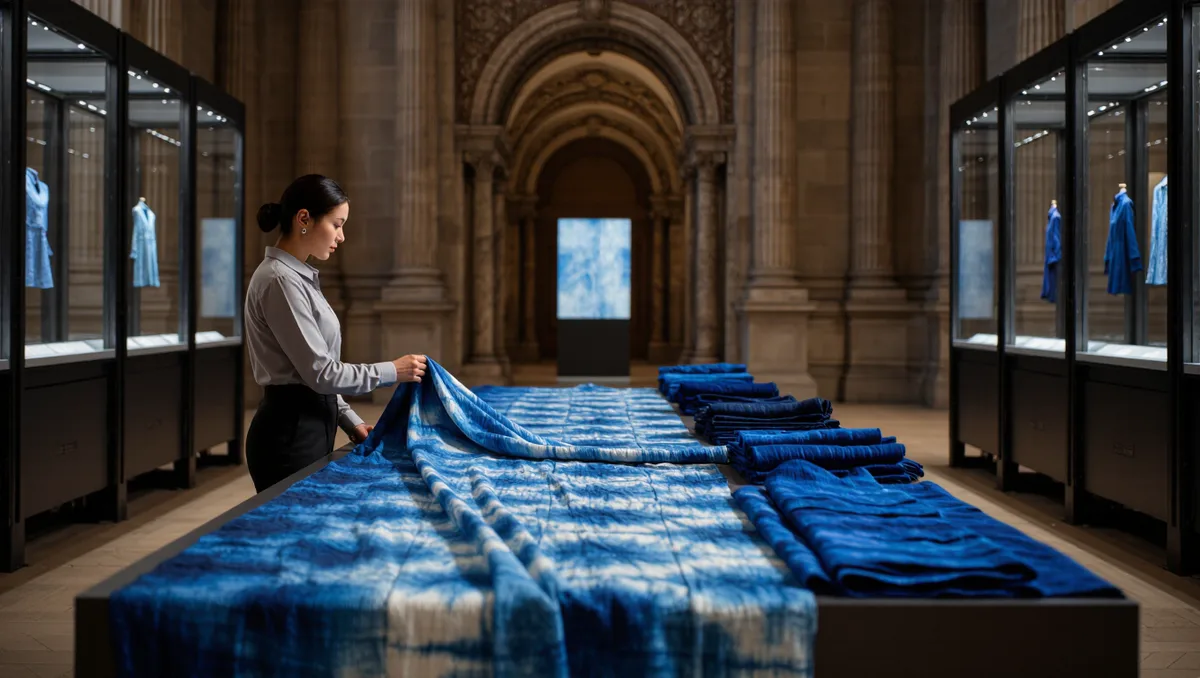
Indigo is the world's working blue, and its route through fashion is longer than most textiles can claim. The dye comes from the leaves of the Indigofera genus, chiefly Indigofera tinctoria, and the Victoria and Albert Museum keeps whole collections of the cloth it colored. Denim carried the blue onto every high street. The shade now reads as ordinary, which is exactly what makes its history worth reading.
Indigo also survives as heritage craft. The sari's own global route makes a natural companion read, six yards of influence traced across fashion.
More stories of cloth and culture live in the culture hub. One caveat governs the dates below: they follow the sources, the museum record for West Africa and the encyclopedia records for the dye and the cloth. That is why indigo dye history reads less like a chemistry lesson and more like a shipping ledger.
What Is Indigo, and Where Does It Come From?
Indigo is an organic compound with a distinctive blue color, obtained as a natural dye from the leaves of Indigofera plants, in particular Indigofera tinctoria. Dye-bearing Indigofera plants were once common throughout the world, and blue colorants remain rare among natural dyes. Today the scale has flipped: most indigo produced is synthetic, around 80,000 tonnes each year as of 2023, per the encyclopedia record.
How Did Denim Carry the Blue Around the World?
Denim is a sturdy, warp-faced cotton twill, first produced in Nímes, France, and its name contracts the French phrase sergé de Nîmes. The classic version is indigo denim: the warp threads are dyed blue while the weft threads stay white, so a pair of jeans wears blue outside and near-white inside. The cloth reached the United States by the mid-19th century, and in 1873 Jacob W. Davis manufactured the first rivet-reinforced denim pants. Workwear had found its color.
The dye suits the cloth. On average a pair of blue jeans requires three to twelve grams of indigo, and its chemistry allows quick stone-washed and acid-washed effects. The shade fades where the wearer bends, which turned every pair of jeans into a small diary of use. Readers following this should also see How Perfume Notes Are Read Like Text: A Culture Explained.
Where Does the Blue Keep Local Meaning?
West Africa keeps the clearest record. Àdìrẹ are indigo-dyed cotton cloths decorated with resist patterns, traditionally made and worn by women throughout the Yoruba region of south-western Nigeria, per the Victoria and Albert Museum. The technique dates to the 1800s, and the term itself, meaning tie and dye in Yoruba, appeared in the early 20th century. Imported European cotton shirting fed a pattern boom in the 1920s.
The V&A's own àdìrẹ collection was purchased in Ibadan in the 1960s, and the museum showed the cloths within its Africa Fashion exhibition, which ran from 2 July 2022 to 16 April 2023 at South Kensington. By the 1960s the textiles had already been tailored into men's shirts and adopted by the American hippie movement. The local blue had gone global twice, once as craft and once as counterculture. We covered a connected angle in Why Fashion and Architecture Keep Borrowing Each Other's Lines.
The route, in three stops:
- The dye: from Indigofera leaves to 80,000 tonnes of annual synthetic output, per the 2023 record.
- The cloth: a twill from Nîmes, riveted into jeans in 1873, three to twelve grams of indigo per pair.
- The craft: àdìrẹ resist patterns by Yoruba makers, collected in Ibadan in the 1960s, shown at the V&A in 2022.
Why Does the Blue Still Read as Universal?
Rarity explains the reach. Blue colorants are scarce in nature, so a cloth that held the color held value, from dye vats in India to wraps in Nigeria to riveted trousers in America. The V&A record makes the point neatly: a museum in London now preserves Lagos-made fashion cloth, and the pattern names still vary from town to town.
None of that needs a forecast. The ledger already shows a blue that worked as currency, as uniform and as statement, often in the same decade. Indigo reads as universal because it has been everywhere, and it carries the receipts.
Conclusion: A Blue With an Address
The route is the point. Indigo left ancient dye vats as a rare natural colorant, crossed into an American workwear uniform, and stayed local enough that a Yoruba pattern could carry its town's name. The same shade serves a museum vitrine and a Saturday jeans drawer.
The verdict from the record is short. Most blues in a wardrobe are pigments. Indigo is a biography, and fashion keeps reissuing it.