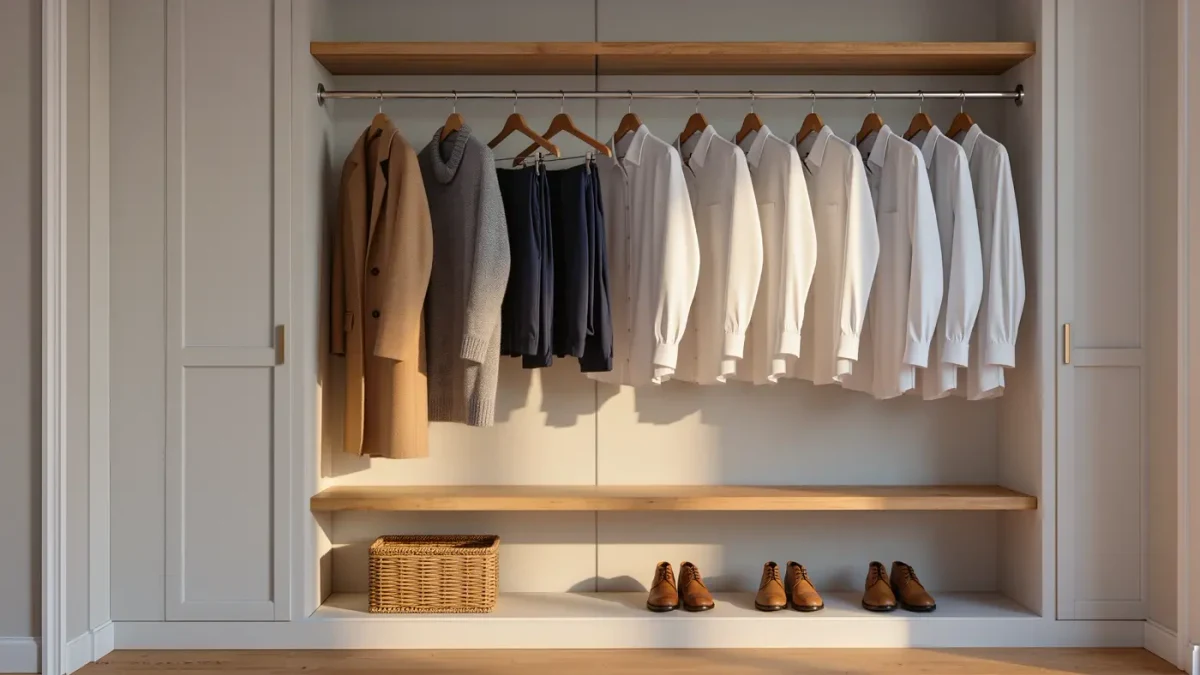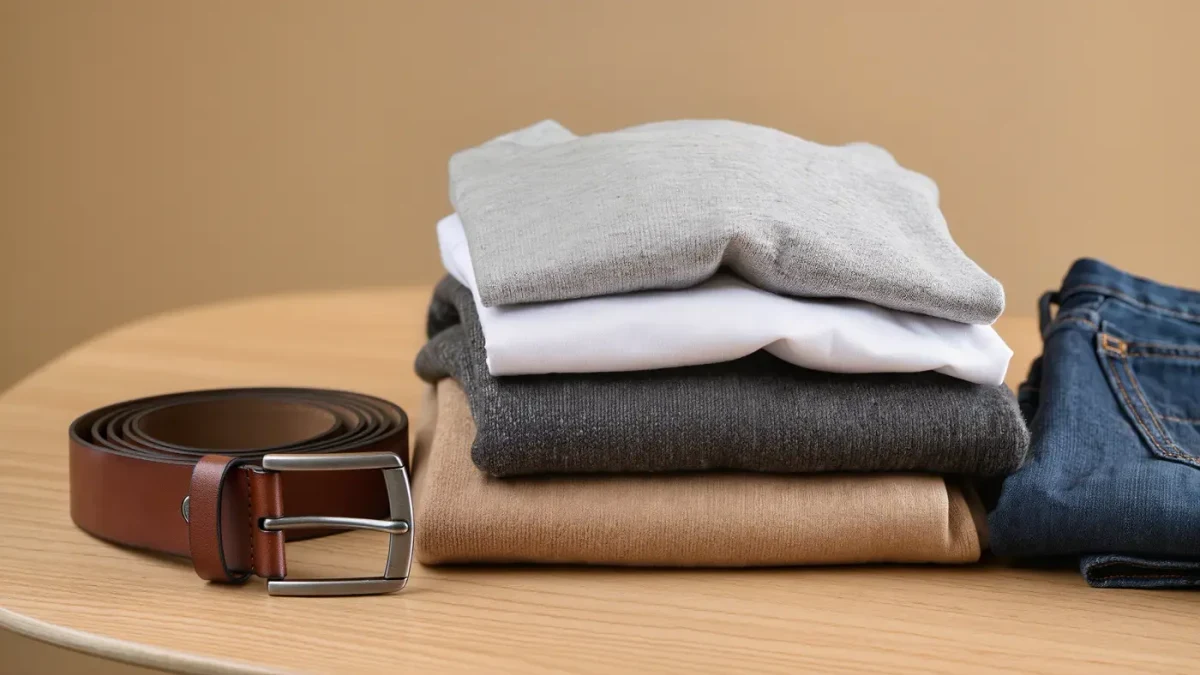
A capsule wardrobe is roughly 30 pieces — tops, bottoms, layers, outerwear and shoes — in a single coordinated palette, where any top and any bottom produce an outfit. The weekend version is real: one Saturday of sorting and counting, one Sunday of list-writing and one targeted shop. The method below, refined through the capsule revival that has run continuously since the mid-2010s, turns an overflowing wardrobe into a working one in two days, and keeps it working for years.
What exactly counts as a capsule wardrobe?
The term, credited to London boutique owner Susie Faux in the 1970s and popularized by a 1985 Donna Karan capsule collection of seven interchangeable work pieces, has always meant the same thing: a small set of garments that interchange completely. The modern working definition used by stylists runs 25 to 40 pieces for one season, excluding underwear, activewear and occasion wear. The number matters less than the property it encodes — total interchangeability — and the palette is what delivers it: roughly six colors, dominated by two or three neutrals, with each piece required to combine with at least two-thirds of the others.
The payoff is arithmetic, not aesthetic: ten tops and five bottoms yield fifty outfits only if everything combines. In an uncoordinated wardrobe of the same size, the real count is often under fifteen. The capsule does not shrink the wardrobe; it stops the wardrobe from arguing with itself.
How do you do the Saturday sort?
Everything out, on the bed or floor, in category piles — tops, bottoms, layers, outerwear, shoes. Then three verdicts per item, applied fast: wear it (fits now, worn this year, in palette or near it), store it (seasonal, sentimental, or awaiting tailoring — boxed and labeled), or release it (unworn a year, unwearable, or kept only out of guilt). The discipline that makes the sort work is the calendar test: anything unworn in twelve months is not a wardrobe piece but a decision deferred. Most wardrobes yield a core of 15 to 25 genuine pieces and a long tail of near-misses; the core is the seed of the capsule.
What does the Sunday count look like?
Count the kept pieces against a target structure rather than a fixed list: around eight tops, four bottoms, four layers, two to three pieces of outerwear, four to five pairs of shoes, plus dresses where relevant. Gaps become the Sunday shopping list — written, bounded, and deliberately short. The list is the weekend's real product: most wardrobes discover they need three to five specific pieces, not the wholesale replacement the overflowing closet had implied. And the buying rule that keeps the capsule honest is one-in-one-out thereafter, which converts the wardrobe from an accumulation into a maintained system.
Which pieces form the actual core?
Across almost every capsule framework the same archetypes recur, because they satisfy the interchangeability test in any palette. The table shows the working core for a temperate four-season wardrobe:
| Piece | Typical count | Job in the capsule |
|---|---|---|
| Fine knit sweaters | 2-3 | Layer alone or under outerwear |
| Quality tees | 3-4 | Base layer, casual anchor |
| One white shirt | 1-2 | Formal top, open layer |
| Straight or wide trousers | 2 | Everyday bottoms, tailoring-adjacent |
| Dark denim | 1-2 | Casual bottoms that pass as smart |
| Blazer or structured jacket | 1 | Instant formality for any outfit |
| Coat | 1-2 | Outer line for the whole season |
| Leather shoes and clean sneakers | 3-4 | Smart and casual registers |
The palette ties the table together. The classic neutrals — navy, charcoal, camel, white plus one or two muted accents — have survived every capsule iteration since the 1980s because their combination rate approaches one hundred percent. Each new piece bought into the palette inherits that rate on arrival, which is why palette discipline, not piece selection, is the capsule's actual engine.
How does the capsule adapt across seasons?
By swapping one layer, not by rebuilding. The temperate-climate pattern: spring and autumn share the core, with the coat and knit weight changing; summer removes roughly a third of the core in favor of lighter bases; winter adds knit density and the serious coat. A practical year therefore runs two capsules — warm and cold — sharing perhaps half their pieces. This is also where storage pays off: the Saturday boxes, labeled by season, become the mechanism by which the wardrobe rotates without re-deciding anything.
What does the capsule cost, honestly?
More per piece and less in total. The math that capsule advocates cite: thirty pieces replaced every two to three years at higher per-piece quality costs less annually than sixty pieces replaced yearly at fast-fashion prices — and the resale market for well-kept neutral pieces, which grew into a multibillion-dollar segment through the early 2020s, returns part of the outlay. The honest caveat is time: the capsule trades shopping hours for maintenance hours — care, storage, the occasional tailor — and suits people who would rather maintain than acquire.
Can the weekend method fail, and what then?
It fails in one predictable way: the palette is skipped and pieces are chosen individually. Individually excellent pieces in competing colors reproduce the original wardrobe at higher prices. The verdict of the method is therefore its first rule restated — palette first, count second, shopping last. Run in that order, the weekend produces not a smaller wardrobe but a combinatorial one, where the morning question stops being "what can I wear" and becomes, permanently, "which of these today."
How do accessories and special pieces fit the system?
Outside the count, deliberately. Accessories — scarves, belts, jewelry — are not counted in the 30 because they multiply outfits without occupying slots; one printed scarf re-titles ten neutral combinations, which is why capsule advocates spend accessory budgets more freely than clothing budgets. Occasion wear follows a parallel track: one black-tie option and one formal-shoes option, stored rather than counted, summoned when the calendar demands. Activewear gets the same exemption. The principle throughout is frequency — anything worn weekly belongs in the capsule and the palette; anything worn yearly belongs in storage; anything worn between the two belongs in the count only if its color plays the palette's game.