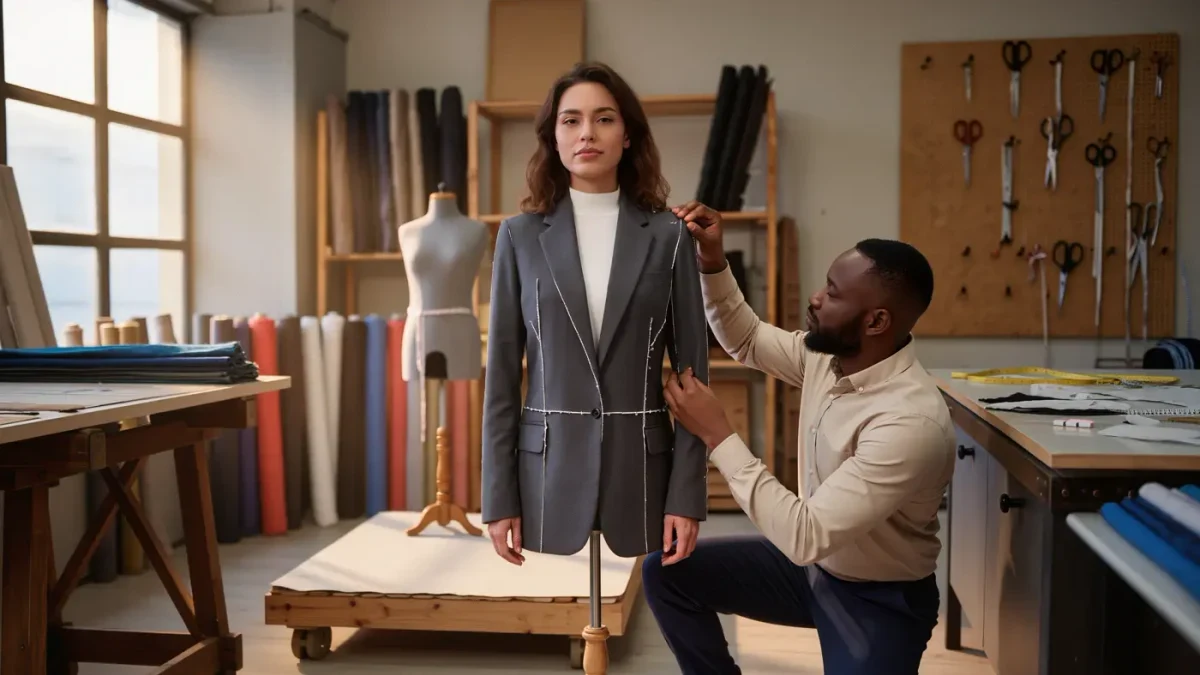
A blazer fits correctly when the shoulder seam ends exactly at the shoulder bone, the collar sits against the neck without gaping, and the sleeve falls to the wrist bone with a quarter to half inch of shirt showing beneath. Everything else — waist suppression, length, lapel roll — can be adjusted by a tailor for modest sums. Everything before that cannot. Here is how to judge a blazer in ten minutes of fitting-room time, in the order tailors themselves use.
Why is the shoulder the first and final check?
Because the shoulder is the blazer's foundation, and it is effectively unalterable. Moving a shoulder seam means re-cutting the armhole, the sleeve crown and often the entire upper canvas — labor that routinely costs more than the jacket did. The standard taught in every tailoring tradition is the same: the seam should sit at the outer edge of the shoulder bone, not spilling onto the upper arm, not short of it. Structured jackets hold their shoulder precisely; soft unconstructed ones, popular across the 2020s, may drop a centimeter past it by design — acceptable only when the drop looks intentional and the sleeve head stays smooth.
A quick check: press a fingertip to the point where neck meets shoulder, then follow the bone outward. Where the finger stops, the seam should be. In a mirror, the shoulder should present one unbroken line from collar to sleeve — no dimple beneath the seam, no ridge above it.
How long should blazer sleeves be?
The sleeve should end at the wrist bone, the small joint at the base of the thumb side of the wrist, allowing a quarter to half inch of shirt cuff to show when arms hang relaxed. This convention has governed tailoring since the mid-twentieth century and survives because it does three jobs at once: it keeps the hand free, it frames a watch or bracelet, and it breaks the jacket's line with a note of contrast. Sleeve shortening at the cuff costs little when the jacket has a functional cuff — though on cheaper jackets the buttons are sewn shut precisely because shortening from the cuff is impossible; those must be shortened from the shoulder, a costlier operation.
Bend the elbow during the fitting. A correct sleeve stays anchored at the wrist without dragging back; if it retreats up the forearm when the arm bends, the sleeve length is compensating for a badly set armhole — another shoulder-adjacent problem no alteration fixes cheaply.
What should the collar and lapels do?
The collar should rest against the shirt collar with no gap — the tell-tale hollow at the back of the neck, tailors call it a collar gap, is the most common fitting flaw and the one that most cheapens an otherwise good jacket. Unlike shoulders, modest collar adjustments are possible: a tailor can release or advance the collar slightly, usually for a modest fee, though large corrections signal the wrong size altogether.
The lapel should roll, not lie flat like paper — a proper lapel has a visible roll line a few centimeters in from the edge, evidence of canvas construction and pressing. When buttoned, the closure point should sit where the wearer wants visual emphasis: a higher stance, common on single-breasted two-button jackets, elongates a short torso; a lower stance lengthens a long one. The lapel should never gape or dimple away from the chest, which indicates the button stance is pulling across a chest or bust that the cut does not allow for.
How should the body of the blazer fit?
Buttoned, the jacket should close without an X of tension lines radiating from the button — the classic sign of a too-small chest or waist — and with no more than a light handful of fabric at the side when pulled. Unbuttoned, the front should hang plumb from the shoulders without swinging open. Length follows proportion rather than a fixed rule: a blazer should roughly cover the seat for a classic cut, though cropped boxy versions that dominated spring collections since 2023 deliberately break that rule and read as fashion rather than tailoring.
Common and fixable: taking in the side seams, which most tailors do for a modest fee and which transforms a boxy high-street jacket into a fitted one. Not fixable: a chest that pulls, shoulders that droop, a collar that stands off by more than a finger's width.
What about sleeves for layering and different frames?
Fitters advise trying a blazer over the heaviest layer it will meet. A blazer meant for knitwear needs a full size of ease through the armhole and chest; one meant for shirts can sit close. Broader shoulders should look for a natural shoulder with minimal padding rather than added structure, which exaggerates; narrower frames benefit from a structured shoulder and higher armhole, which add apparent width and freedom of movement at once. A well-set armhole is higher than streetwear instinct suggests — high armholes restrict nothing and let the whole jacket move with the body.
| Check point | Correct | Fixable by tailor? |
|---|---|---|
| Shoulder seam | Ends at shoulder bone | No — buy it right |
| Collar | Rests on shirt, no gap | Small gaps, yes |
| Sleeve length | At wrist bone, cuff shows | Yes, from cuff or shoulder |
| Buttoned front | No X-pull, smooth lapel | Chest pull, no; side seams, yes |
| Length | Covers seat (classic cut) | Shortening, yes |
Can an off-the-rack blazer ever fit like bespoke?
With one fitting session, yes — close enough that most observers cannot tell. The working sequence used by stylists: buy for shoulders and chest, then commission the standard trio of alterations — side seams taken in, sleeves set to the wrist bone with a cuff showing, hem or sleeve nip where proportion asks. Industry estimates put a basic alteration package at a fraction of the price of a bespoke jacket, and the result is a garment built to the wearer's shoulder line twice over: once in the factory, once at the tailor's table.
What is the single test that predicts a blazer's wear?
The hug test, and the verdict it delivers: button the jacket, fold the arms forward as if embracing someone, and look for the jacket's response. A well-fitted blazer rises slightly at the shoulders and settles back without strain; a badly fitted one resists across the back, pulls the lapels out of alignment, or lifts the hem at the front. A blazer is worn in motion — reaching, driving, embracing — and only the fitting that respects motion deserves the purchase.