Costume design turns clothing into character through deliberate, legible choices — silhouette, condition, color — that tell an audience who a person is before a line is spoken. The craft's institutional proof is the Academy Award for costume design, awarded since 1949, whose record books read like a history of fashion thinking: Edith Head won eight, still the most for any woman in Oscar history, while Milena Canonero and Colleen Atwood collected four apiece. In film, clothes do not reflect character. They create it.
What does a costume designer actually decide?
Far more than period accuracy. The designer's brief covers every worn frame: how a character's class registers in fabric weight, how arc is encoded in changing palettes, how a costume ages across a shoot that films scenes out of order for months. Sandy Powell, a three-time Oscar winner for films including "Shakespeare in Love" and "The Aviator," has described the work as building a visual biography — each garment a chapter with a beginning, middle and end. The designer also negotiates with the camera: a pleat that reads as elegant at a dinner table reads as noise in motion, so every textile is chosen twice, once for the eye and once for the lens.
This is why costume design sits closer to writing than to shopping, whatever the red-carpet clichés suggest.
Why is Edith Head the craft's benchmark?
Head ran Paramount's costume department for decades beginning in the 1930s and built a career on clothes that were characters first, fashion second — dressing everyone from Barbara Stanwyck in "The Lady Eve" to the 1961 glamour of "Breakfast at Tiffany's" era Hollywood, and collecting 35 nominations along the way. Her method was collaboration with stars as co-authors: she famously tailored to an actor's self-image, reasoning that an actress who felt like herself would act like the character. The approach set the template for the discipline's modern form — costume as psychology, with the designer as the actor's first scene partner.
How does costume rewrite fashion history?
By choosing interpretation over reproduction. Milena Canonero's costumes for Stanley Kubrick's 1975 "Barry Lyndon" recreated 18th-century dress with museum-grade fidelity — and won her first Oscar; her work on "Marie Antoinette" in 2006 did the opposite, inserting Converse sneakers and candy pastels into Versailles to make history feel adolescent and immediate. Both approaches won Academy Awards because both served character. Jacqueline Durran pushed the method further in Greta Gerwig's 2019 "Little Women," deliberately mixing 1860s silhouettes with anachronistic pieces to mirror the novel's own structure — clothing assembled from memory and household economy, exactly as the March sisters would have experienced it.
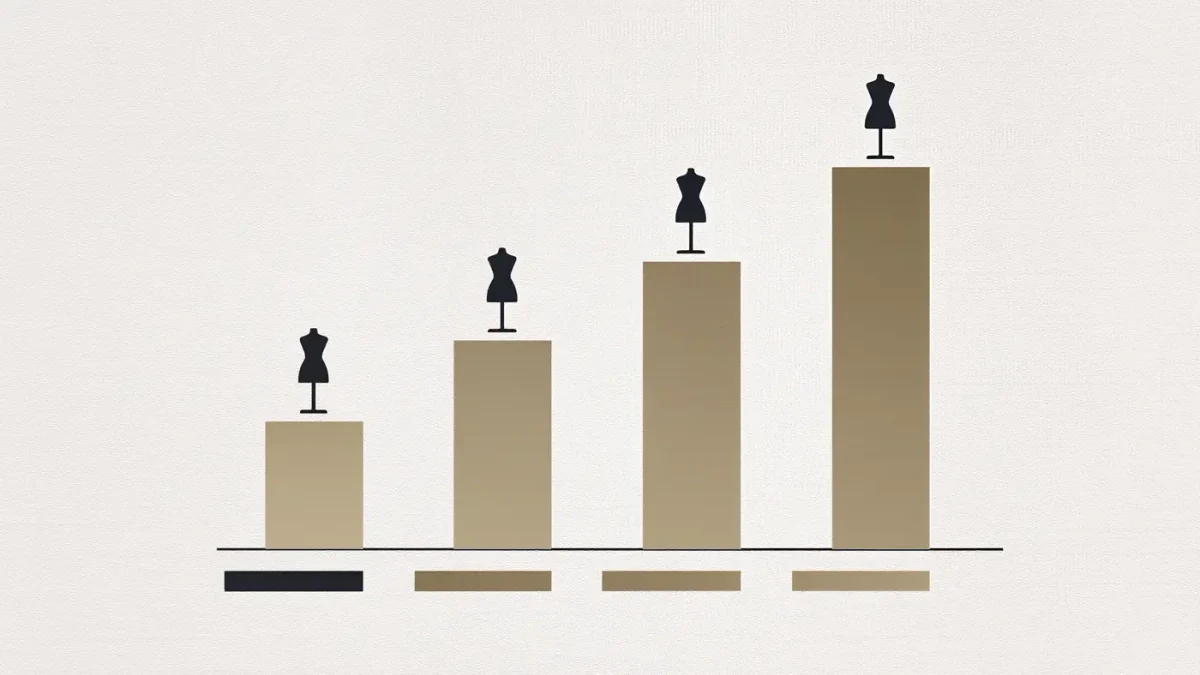
| Designer | Oscars | Signature method |
|---|---|---|
| Edith Head | Eight | Costume co-written with the star's self-image |
| Milena Canonero | Four | Period fidelity or deliberate anachronism |
| Colleen Atwood | Four | Textural realism inside fantasy worlds |
| Sandy Powell | Three | Visual biography across a character's arc |
How does a costume survive a production schedule?
Through engineering that audiences never see. A single principal costume may exist in a dozen duplicates — pristine for early scenes, distressed through successive stages for later ones, each copy tagged for continuity so a tear lands on the same shoulder months after the first scene was filmed. Stunt versions carry hidden stretch panels; dance numbers require seams reinforced to survive choreography; water scenes demand fabrics weighted to move correctly when soaked. Designers also plan for the camera's truth that fabric reads differently at speed: a wool that hangs beautifully on an actor standing still can strobe and flutter into visual noise the moment they run. This invisible labor explains why the craft's best work rarely looks designed at all. The costume that wins the Oscar usually appears inevitable, as if the character simply owned those clothes — and inevitability, on a film set, is the most engineered quality there is.
What happens when fashion and costume collaborate directly?
The results divide critics and define careers. Paul Thomas Anderson's "Phantom Thread" in 2017 dramatized the couture atelier itself, with costume designer Mark Bridges building a fictional 1950s London house — and winning the Oscar for a film about the cost of making clothes beautiful. On the other side, luxury houses loaning ready-made looks to productions usually flattens character into advertising; the garment arrives pre-sold, and the audience reads the brand, not the person. The strongest screen costume is therefore almost always unbranded: it borrows technique from fashion — cut, drape, color theory — while refusing fashion's answer of what anyone should actually wear.
What does the future of the craft look like?
Digital, in part, but not in the way predicted. Virtual costumes and digital garment libraries have entered the workflow — useful for crowd scenes, floating capes and things that cannot physically exist — yet the awards and the prestige keep flowing to handmade work, because audiences sense the difference in how cloth falls. What has genuinely changed is research access: archive digitization lets a designer study a 1930s tailor's cutting notes from a laptop that once required an appointment in a storage facility, and sustainability pressures have pushed productions toward rental houses, re-dyeing and remnant sourcing instead of building everything from scratch. The craft's core skill, though, remains stubbornly analog — reading a script, finding the person inside it, and choosing the first garment that person would reach for. Software can render any dress in seconds. Only a designer can say which dress is true.
Which films changed how audiences dress?
A short, permanent list. The white dress of Marilyn Monroe in 1955's "The Seven Year Itch," designed by William Travilla, became a template understood by people who never saw the film. Diane Keaton's layered menswear in 1977's "Annie Hall" — assembled with designer Ruth Morley — entered real wardrobes within a season and never left. Uma Thurman's black bob and cropped trousers in "Pulp Fiction" a generation later proved a costume could restart a beauty standard. These looks worked for the same reason the craft's best work works: they were not fashionable, they were specific, and specificity is what audiences actually copy.
Is costume design fashion's mirror or its rival?
Neither — it is fashion's research department. The ateliers watch film for what silhouettes mean emotionally; the awards archives, preserved in collections from the Academy to the Library of Congress's National Film Registry, now document a century of how clothes signify on screen. The verdict, three-quarters of a century after the category's first Oscar: costume designers are the only people in the industry who use clothing purely as language — and every wardrobe on the street is a little better-spoken for it.