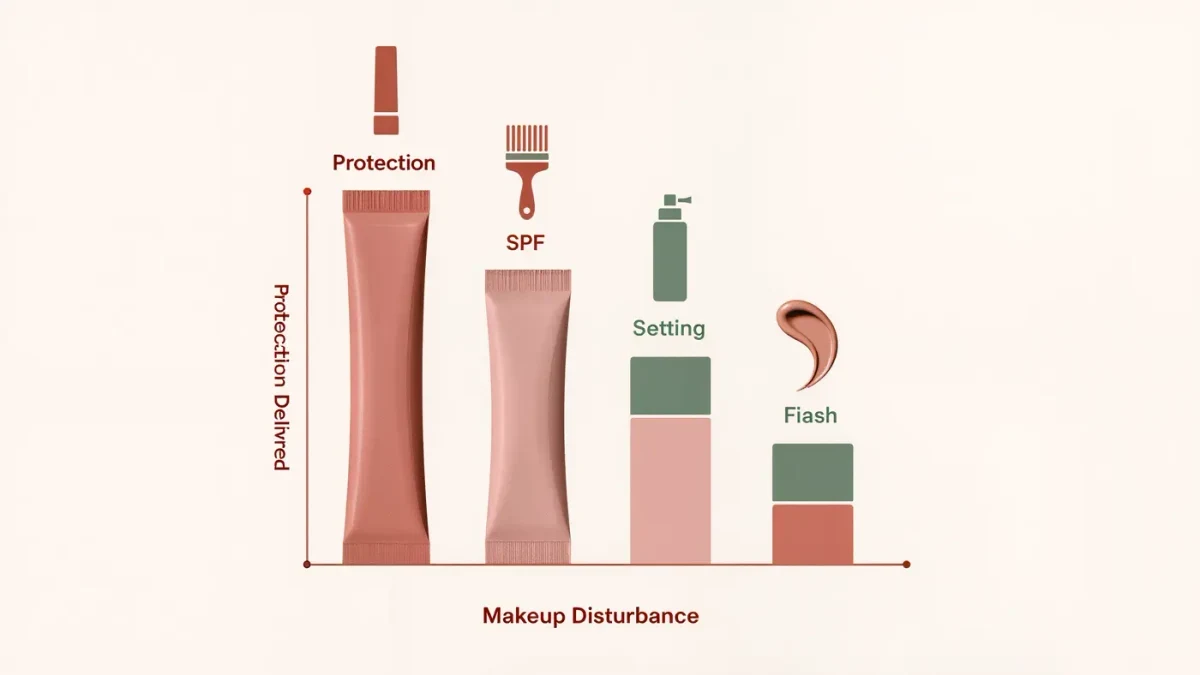
The two-hour reapplication rule is real, and makeup is not an exemption: dermatological guidance from the American Academy of Dermatology calls for sunscreen every two hours during daylight exposure, and a morning application simply expires into the afternoon. Over makeup, the working hierarchy is straightforward — a sunscreen stick pressed over the surface beats a powder beats a mist, and a mist alone beats nothing. None of the methods is as good as a fresh half-teaspoon of cream on bare skin, which is the honest sentence the product category skips. But measured against the realistic alternative — a fading morning layer and a resolute face — the tools earn their place in a handbag.
Sunburn, unusual pigment change or moles that change belong with a dermatologist, not a makeup tutorial.
Why does sunscreen need reapplying at all?
Two forces erase a morning application, and neither cares how expensive it was. First, mechanics: face touching, mask straps, collars, sweat and simply the day's friction remove film physically. Second, chemistry: UV filters degrade as they work, absorbing photons and breaking down — a phenomenon photochemists call photostability limits, and the reason even the most elegant formula carries the two-hour instruction. The half-teaspoon dose tested on faces (the 'two-finger' rule) is measured for a fresh, even film; by mid-afternoon, studies of real-world wear show most of it has migrated, wiped or thinned. The arithmetic is unforgiving: an 8 a.m. application is protecting at partial strength through the afternoon light that matters most.
Which reapplication method works best over makeup?
| Method | How it works | Verdict |
|---|---|---|
| Sunscreen stick (SPF balm) | Solid formula swiped and pressed with fingers over makeup; displaces little | The working default — highest delivered dose, minimal disturbance |
| SPF powder | Mineral powder through a brush; absorbs shine, adds measured protection | Best compliance tool; dose depends on generosity of dusting |
| SPF setting mist | Aerosol or pump spray over finished makeup | Convenient, uneven coverage; best as a top-up between stick applications |
| Cream over makeup | Fresh layer pressed on with a sponge or palms | Highest protection, heaviest disturbance — reserve for beach, not the office |
| Skipping reapplication | Morning layer only | Partial protection by afternoon; the default the industry pretends not to see |
The stick deserves its top billing on physics alone: a solid balm lays down a measured film without solvents, so foundation does not break, and pressing with fingertips redistributes rather than removes. Powders — typically mineral, titanium dioxide or zinc based — solve the compliance problem that defeats everything else, because people actually enjoy using them, though laboratory measurements suggest most users dust on less than the tested dose. Mists are the weakest solo act, spraying unevenly and delivering an unknown fraction to the skin, but they refresh the mid-face between more deliberate applications, and a degraded top-up still outperforms a bare afternoon.
When does reapplication actually matter?
Context prices the two-hour rule honestly. Continuous outdoor exposure — beach, terrace lunch, hiking — is the full-dose scenario: every two hours, after swimming, after heavy sweating, no exceptions — the interval federal cancer-agency guidance lists among core sun-safety steps. Office days behind glass compress the problem: UVA penetrates windows, so a morning application plus one stick pass before the commute home covers the realistic exposure. Bright overcast afternoons demand nearly the same diligence as clear ones, since UVA ignores cloud cover. And anyone sitting by a window — a café, a train, a desk — inherits more exposure than the room suggests. The practical schedule most dermatologists sketch: full cream in the morning, a stick or powder pass at lunch on any day that includes daylight, and a mist in the bag for long afternoons out.
How do you reapply without ruining makeup?
- Blot first. Oil and sweat lift film unevenly; a tissue or blotting paper gives the new layer a surface to bond to.
- Press, do not rub. Sticks and cream applied with a pressing motion disturb foundation least; rubbing erases.
- Dust powder generously. The tested dose is higher than it feels — a thorough pass over face and neck, not a wink of shimmer.
- Aim mists close. Hold within a few inches, saturate rather than freshen, and close eyes and lips.
- Do the hands and ears. Reapplication habits always skip them first; they are among the most sun-damaged sites dermatologists see.
The verdict: reapplication is a compliance problem wearing a chemistry costume. The stick is the workhorse, the powder is the habit-former, the mist is the bridge — and the day planned around any of them ends better protected than the one that trusted a single morning layer. SPF over makeup is not a perfect system; it is merely the difference between partial and expired, and that difference compounds across a summer.
What about water-resistant formulas — do they buy more time?
A fixed, regulated amount: water-resistance labeling in the United States carries one of two tested claims, 40 minutes or 80 minutes, after which the tested protection is gone and reapplication is instructed. The label measures only water and sweat exposure under controlled conditions, not towel-drying, clothing friction or makeup on top, so real-world endurance is usually shorter. A water-resistant stick is nonetheless the smartest format for reapplication days that involve swimming or heat, because the solid film adheres better than a lotion and can be reapplied directly over damp skin. The reading habit worth keeping: check which number the bottle carries — 40 or 80 — and count from the water, not from the application. No sunscreen of any price is waterproof; the word itself has been banned from US labels since the FDA's 2011 rules precisely because it overstayed its evidence.
How does one build a realistic midday habit?
Compliance research in dermatology is blunt: people reapply when the product lives where the moment happens. A stick in the work bag, a powder in the desk drawer, a mist in the car — placement outperforms intention, the same logic that makes toothbrush adjacency the backbone of morning SPF. The lunchtime anchor is the single highest-yield habit: any day containing daylight gets one deliberate pass at noon, which splits the exposure gap where the two-hour rule actually breaks. Travel days and outdoor plans get the full kit plus a hat. And the standard deserves a final honest calibration — reapplying over makeup is the optimization layer for people who wear makeup, not a substitute for the morning half-teaspoon, and never an argument for skipping the first application. Partial protection, refreshed on schedule, is the realistic ceiling of a working life spent outdoors-adjacent; the routine that reaches it wins every comparison against the one that does not.