Sleep quality shows on skin, and the claim now has a clinical citation. A frequently cited study commissioned through Case Western Reserve University and published in Clinical, Cosmetic and Investigational Dermatology found that poor sleepers showed significantly more signs of intrinsic ageing — fine lines, uneven pigmentation, reduced elasticity — and, strikingly, recovered more slowly from environmental stressors such as UV exposure than good sleepers of the same age. Skin repairs on the night shift: cell turnover peaks, barrier lipid synthesis accelerates, and the hormones governing repair follow the circadian clock. That is the science beneath the phrase 'beauty sleep,' and it is a stronger argument than any serum ad has managed.
Chronic insomnia and suspected sleep disorders are medical conditions with medical treatments, and no cosmetic routine substitutes for them.
What does skin do at night?
The skin runs its own circadian program. Research into chronobiology shows that DNA repair and cell proliferation peak in the evening and overnight hours, while daytime biology is organized around defense — antioxidant capacity, UV response. Blood flow to skin rises at night, sebum production dips toward the evening peak's end, and transepidermal water loss increases in the second half of the night, which is why skin can feel drier at dawn even after a perfect evening routine. Cortisol, the stress hormone that suppresses repair and inflames tissue, follows a daily arc of its own, falling through the evening to a trough in early sleep; sleep deprivation flattens that arc and keeps repair chemistry throttled. A frequently cited experimental study found that even a single night of sleep deprivation measurably increased visible signs of fatigue — dark circles, redder eyes, duller skin — when observers rated photographs.
What did the poor-sleeper study actually find?
The study, led by dermatologist Elma Baron and published in 2013, compared long-term good sleepers — roughly seven to nine hours, by self-report and quality scoring — with poor sleepers, under six hours. The poor-sleep group carried more fine lines, more uneven pigmentation, more laxity and reduced elasticity. The recovery tests were the more persuasive half: when skin was exposed to UV and to mechanical stress (tape stripping), good sleepers repaired faster, with recovery around 30 percent better on the tested measures. Chronic sleep loss, the authors concluded, is associated with reduced skin health and accelerated intrinsic ageing — observational data, worth stating precisely: an association, not a proof of causation, but one that aligns with everything chronobiology has measured since.
| Sleep pattern | Skin findings in the 2013 study | Recovery from stressors |
|---|---|---|
| Good sleepers (7–9 h) | Fewer fine lines, more even tone, better elasticity | Faster; ~30% better recovery on tested measures |
| Poor sleepers (<6 h) | More signs of intrinsic ageing at the same age | Slower repair after UV and barrier disruption |
Does a night routine add anything to sleep itself?
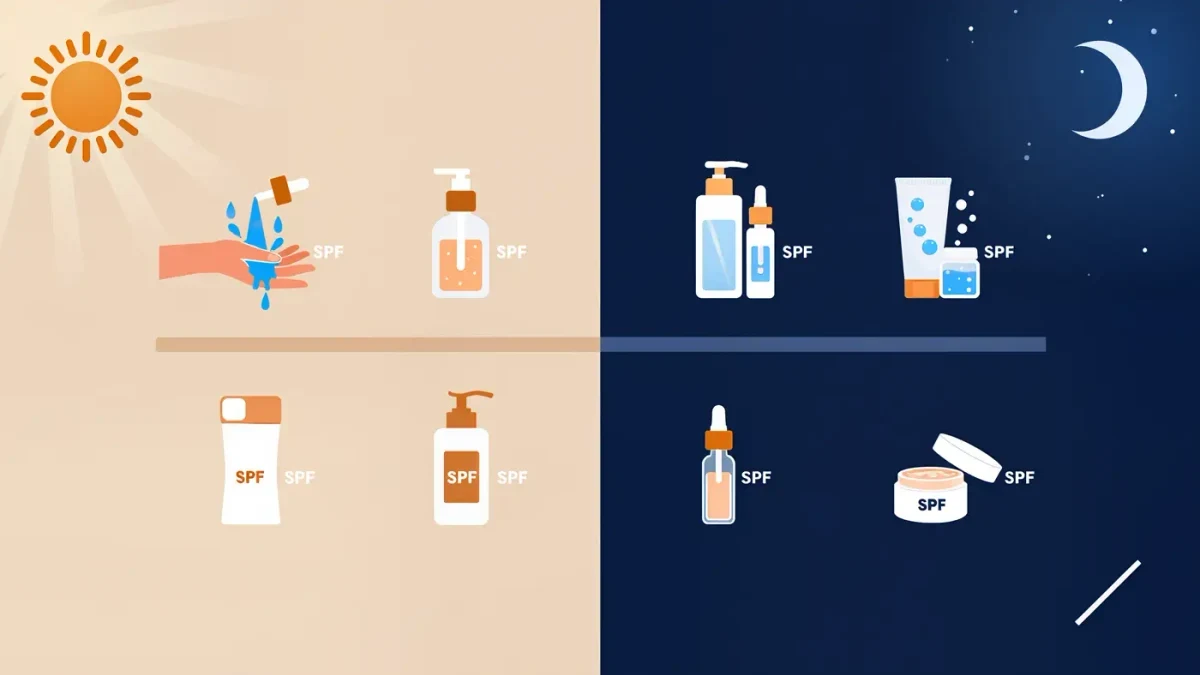
Yes, as a supporting act. Night is when leave-on actives earn their keep, because the skin is not simultaneously defending: retinoids, prescribed at night for decades partly because light degrades older forms, work with the turnover peak rather than against it. Occlusive night creams meet the overnight rise in water loss — an evidence-adjacent logic behind 'slugging,' the trend of sealing a routine with petroleum jelly, useful for dry skin and overkill for oily. Humidifiers earn their shelf space in heated bedrooms, since winter indoor air can sit at desert-level humidity. Silk pillowcases and clean pillows are hygiene, not magic — friction matters modestly, bacteria matter more. What no night product does is substitute for the hours; the routine optimizes a repair program that only sleep runs.
Can you repair a sleep-debt face?
Largely, yes, and the sequence is unglamorous: restore the schedule first, since recovery research shows the repair cascade resumes as soon as sleep normalizes; support the barrier while it works, with a plain moisturizer and sunscreen through the day; and expect the visible signs — dullness, dark circles, puffiness — to track the new schedule within a week or two rather than overnight. Structural changes accrued over years of short sleep will not fully reverse, which is the honest limit of every repair claim in beauty. The practical protocol, per sleep-medicine guidance, holds regardless: a consistent bed and wake time, darkness, a cool bedroom, and caffeine retired early enough that it does not thin the deep-sleep stages where growth hormone does its tissue work.
The verdict: sleep is the first leave-on treatment. The industry sells the optimization layer — retinoids, occlusives, humectants — and it is worth having, but the underlying program is free, runs nightly, and outperforms everything applied on top of it.
What about dark circles — are they sleep or anatomy?
Both, in fixed proportions that sleep marketing obscures. Periorbital darkness has four overlapping causes: thin under-eye skin revealing the muscle and vessels beneath (genetic), shadowing from tear-trough anatomy (structural), accumulated pigment (chronic, sun- and rubbing-driven), and the fluid stasis plus pale skin of a short night (behavioral). The last category is the only one a good week of sleep touches, which is why a rested Monday can still show Thursday's circles: the structural and vascular components persist regardless of schedule. Cold compresses, adequate hydration and an elevated pillow help the fluid component modestly; pigment responds to sunscreen and, over months, gentle actives; the anatomical kind answers only to cosmetic procedures, and often best to none. The honest routine treats the behavioral slice, forgives the genetic one, and never promises more than a fortnight of good nights can deliver.
How do shift work and late screens change the picture?
The circadian system reads light, and modern evenings feed it the wrong signal. Blue-spectrum light in the hours before bed delays melatonin release and pushes the whole repair program later, which is why the hour before sleep matters as much as its total length. Shift work compresses the problem: studies of night-shift workers report altered skin barrier function and higher rates of dermatological complaints, consistent with a repair schedule permanently out of sync with daylight. Nobody need adopt candlelight literally — dim, warm lighting after sunset, screens on night mode, and a consistent wake time even after a late night preserve most of the rhythm. The skin keeps score in weeks, not nights; the goal is a schedule it can predict, not a monastic one.