A damaged skin barrier announces itself with a short list: tightness after cleansing, stinging from products that never used to sting, flaking that moisturizer does not fix, and redness that lingers. The repair protocol is equally short — strip the routine down to a gentle cleanser, a barrier-focused moisturizer and sunscreen, and hold it there for roughly four weeks while the stratum corneum rebuilds its lipid structure. The skin renews itself on a cycle of about 28 days in healthy adults, which makes a month the honest length of a repair commitment, not the 48 hours the internet promises.
First, the standing note: NOOR publishes information, not medical advice. Widespread rash, cracking that weeps or bleeds, or symptoms that persist beyond a few weeks of simplified care belong with a dermatologist, because several conditions — eczema chief among them — masquerade as a tired barrier.
What is the skin barrier, exactly?
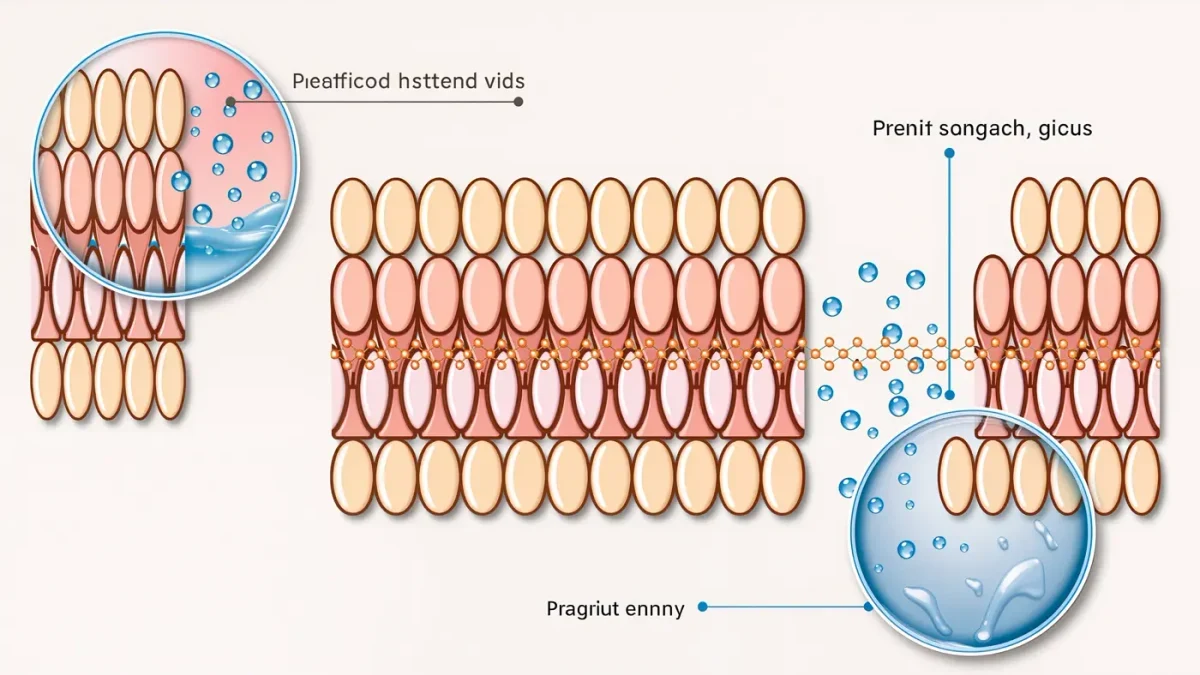
The barrier is the outermost layer of the epidermis, and dermatologists describe it with a classic analogy: bricks and mortar. The bricks are corneocytes — flat, dead skin cells packed with natural moisturizing factor, a collection of humectant compounds including amino acids, urea and lactate that holds water inside the cells. The mortar is the lipid matrix between them, a precise mixture of roughly 50 percent ceramides, 25 percent cholesterol and 15 percent free fatty acids, assembled by the skin into stacked layers that water cannot easily cross. Published work from the laboratory of dermatologist Peter Elias, who led much of the field's foundational research, established that this lipid architecture controls transepidermal water loss, the standard measure of barrier integrity.
When the lipid matrix thins or scrambles, two things follow: water escapes faster than it should, and irritants and allergens slip in more easily. That double failure explains why a damaged barrier feels simultaneously dry and inflamed.
What damages the barrier in ordinary life?
- Over-cleansing. Harsh sulfate surfactants and hot water dissolve the lipid mortar faster than skin can replace it. A tight, squeaky feeling after washing is a verdict, not a compliment.
- Actives overload. Layering exfoliating acids, retinoids and vitamin C at full strength, several days a week, outpaces the skin's repair rate. The barrier keeps a ledger, and it settles accounts as sensitivity.
- Climate. Low humidity — winter heating, long-haul flights, arid summers — pulls moisture straight through a compromised matrix.
- Physical friction. Aggressive scrubs, cleansing brushes and rough towels abrade the surface layer with no cosmetic upside.
- Skip-the-sunscreen days. UV degrades barrier lipids directly; sunburn is barrier damage in its most legible form.
How do you repair a damaged barrier?
- Pause the actives. Acids, retinol and vitamin C go on sabbatical for two to four weeks. Nothing rebuilds while it is still being dismantled.
- Cleanse gently, once at night. A mild, low-foaming cleanser and lukewarm water; a plain water rinse or even nothing is often enough in the morning.
- Feed the mortar. Choose a moisturizer built around the barrier's own materials: ceramides, cholesterol and fatty acids together, plus humectants — glycerin, hyaluronic acid — and an occlusive such as squalane or petrolatum to seal the surface. Studies show repair formulas work best when the three lipid classes are supplied in barrier-like ratios, not as a single-hero ceramide claim.
- Keep sunscreen. A gentle broad-spectrum SPF 30 shields the rebuilding tissue from UV's lipid damage. Mineral filters tend to sting less on compromised skin.
- Reintroduce actives one at a time, at reduced frequency, after about a month of calm. Add back a single ingredient every two weeks and listen for complaints.
How long does barrier repair take?
Acute damage — one overzealous acid night, a week of over-cleansing — usually quiets within days and restores fully within two to four weeks, in line with the epidermal renewal cycle. Chronic damage built over seasons of over-exfoliation takes correspondingly longer, and deeply compromised skin may need months of disciplined simplicity. The progress markers are unglamorous and reliable: stinging fades first, then tightness, then flaking. Skin that has stopped reacting is skin that has finished rebuilding.
Can you prevent barrier damage long term?
Yes, and prevention is mostly arithmetic. The routine that damages less than it builds is short: a mild cleanser, one moisturizer that suits the season, daily sunscreen, and actives dosed like medicines — deliberate, scheduled, never all at once. Humidity helps; a bedroom humidifier in winter is an underrated skincare product. And the boring verdict holds: the barrier is a structure, not a mood, and structures stay sound through steady maintenance, not heroic interventions. When sensitivity arrives, the fix is subtraction, performed patiently, for a month.
Which ingredients matter most in a repair moisturizer?
The shopping list shortens to a handful of proven players. Ceramides rebuild the mortar directly, and clinical work shows they do the job best alongside cholesterol and fatty acids rather than alone. Humectants handle the water side: glycerin, the workhorse of the category, draws moisture into the corneocytes, while hyaluronic acid holds it near the surface. Urea and lactic acid, at gentle concentrations, both hydrate and signal the skin to produce more of its own natural moisturizing factor. Occlusives — petrolatum, mineral oil, squalane, shea butter — then form a film that cuts transepidermal water loss dramatically; petrolatum remains the benchmark, reducing water loss by up to 98 percent in clinical measurements, which is why pediatricians have recommended plain petroleum jelly for compromised skin for generations. Fragrance and essential oils add nothing at this stage and give reactive skin more targets, so the elegant choice on a repair month is the plainest jar on the shelf.
What does barrier care look like through the year?
The barrier's needs shift with the calendar, and the maintenance routine shifts with them. Winter heating and cold wind demand richer creams and a nighttime occlusive layer; summer humidity lets lightweight lotions carry the job, with sunscreen assuming most of the protective weight. Travel compresses the problem — a long flight is eight hours in desert-grade air, and a moisturizer in the seat pocket is the fix. The constant is the arithmetic: hydration in, water loss down, UV blocked, and actives dosed at a rate the skin can pay for. A barrier kept on that budget rarely sends the emergency signals that start this article — and when it does, subtraction plus four patient weeks remains the most reliable treatment in beauty.