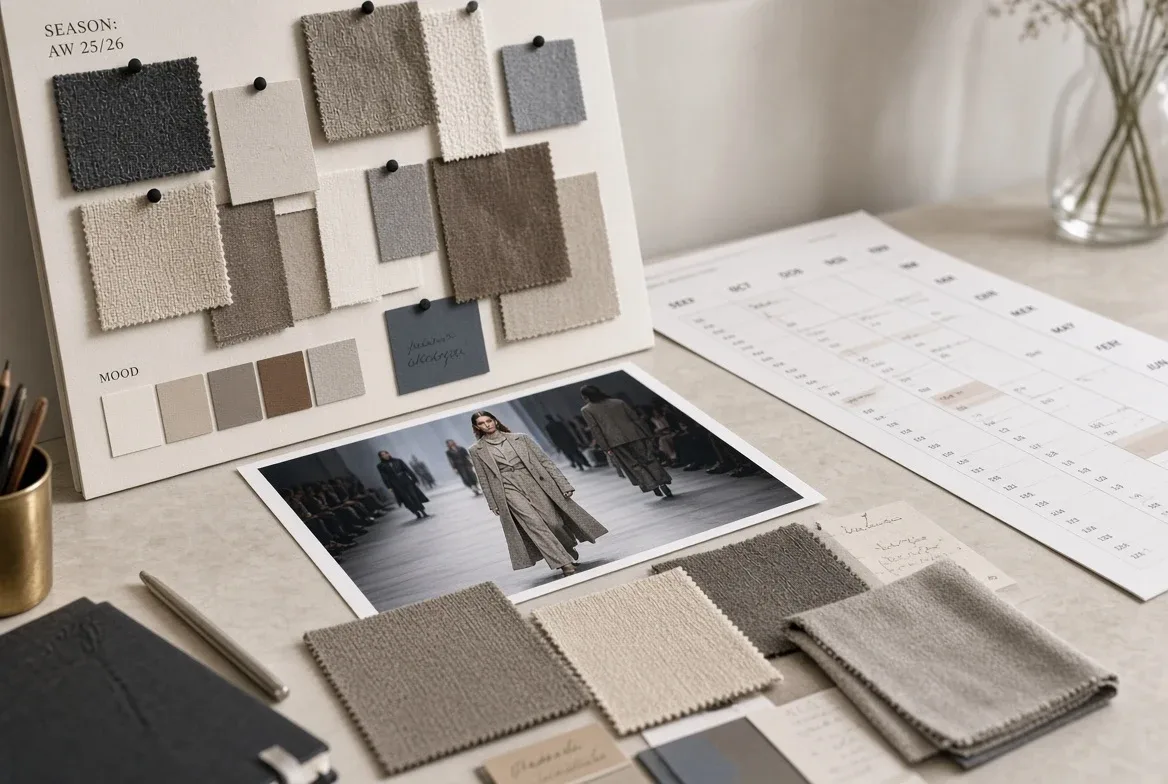
What lands on the runway this season was decided long before the invitations went out. Trend forecasters work in horizons of months to years, reading culture, retail data, and street style for signals, then testing those reads against sales and client briefings — a process that WGSN's published methodology and Women's Wear Daily's reporting on working forecasters both lay out in detail, and it explains why a color or a silhouette can feel inevitable by the time it reaches a store.
How Far Ahead Do Forecasters Actually Work?
Cotton Incorporated's fashion marketing team builds its seasonal trend presentations roughly eighteen months before the looks they inform reach fashion week, according to Women's Wear Daily's reporting on the company's process. Linda DeFranco, the company's director of fashion marketing, described the scope of that lead time to the outlet: "We analyze cultural trends, global trends and the evolution of things like fashion, fabric, consumer sentiment, the economy and the psychology of the consumer." Her colleague Lauren Williams, a trend forecaster on the same team, works alongside her on research trips built around that timeline.
WGSN, one of the larger forecasting firms serving the industry, structures its own work around three separate horizons rather than one lead time: a short-term window of zero to twelve months for tactical decisions already in motion, a mid-term window of twelve to thirty-six months for product design, and a long-term window of three-plus years reserved for strategic and disruptive shifts, per the company's own published methodology. A single forecasting house, in other words, is rarely predicting just one season at a time — it is running several timelines at once.
What Signals Do They Actually Track?
The inputs are less mystical than the output suggests. Cotton Incorporated's forecasters conduct international research trips to study markets and street style, examine what has and has not sold through to clearance racks, track online conversation, and cross-reference all of it against measurable data such as retail sales and disposable income, Women's Wear Daily reported. WGSN describes a comparable but more codified process: signal feeds from creators, retail shelf data, and runway coverage, combined with what the firm calls an "IRL layer" of in-house regional experts who are meant to catch real-world shifts before they surface on social media, all of it filtered through a proprietary framework the company calls its STEPIC lens — shorthand for society, technology, environment, politics, industry, and creativity and culture.
The output of that process, at Cotton Incorporated, tends to be a small number of major directions rather than a long list: roughly three headline trends per seasonal presentation, later adapted for individual client brands and their specific customers.
Where Does Artificial Intelligence Actually Fit In?
The forecasting industry has added machine-driven tools without fully replacing the human read. Heuritech, a Paris-based firm that uses artificial intelligence to detect fashion trends online, won LVMH's inaugural Innovation Award in 2017 and counts Nike, Prada, and Decathlon among its clients, Women's Wear Daily reported when the firm was acquired by the data intelligence company Luxurynsight in December 2024 — a deal that folded Heuritech's roughly twenty-five-person team, many with doctorates in artificial intelligence and machine learning, into Luxurynsight's larger Paris operation.
WGSN takes a similar position on where automation belongs in the process: the firm describes artificial intelligence, including its own multivariate modeling tools, as an amplifier that surfaces patterns in the data rather than a substitute for the analysts who decide what those patterns mean. That framing matters for how a reader should weigh any single trend call — a machine can flag that a silhouette is gaining traction online; deciding whether that traction will still matter at retail remains, by the forecasters' own account, a human judgment.
How Does a Trend Get Signed Off?
Even inside a single forecasting house, not every idea that gets researched gets published. WGSN says each trend it considers is reviewed against fifteen weighted criteria — including commercial opportunity, longevity, and regional relevance — and assigned a score from zero to one hundred; only trends scoring thirty or above are published under the company's name. Each published trend is then paired with what WGSN calls a Trend Investment Projection, a recommended posture for a client ranging from "explore" or "test" at the cautious end to "invest," "expand," "protect," or "decline." The company describes the resulting slate as a living portfolio, re-scored twice a year against how the season actually played out.
That built-in re-scoring is itself worth noting: forecasters revisit their own calls and grade them against results, rather than treating a published trend as a fixed prediction. It is one reason a single house's forecast is better read as an informed expectation, attributed to its source, than as a guarantee of what any one closet will hold next year.
Why Does a Well-Researched Forecast Still Miss?
The scoring, the research trips, and the layered timelines are all built to reduce error, not eliminate it. WGSN's own description of its process — biannual re-scoring, monthly trend reviews, a portfolio treated as "living" rather than fixed — is itself an admission that some published calls will need revising once a season plays out against real sales. A trend built on an eighteen-month lead time, in Cotton Incorporated's case, or on WGSN's three-year strategic horizon, is also a bet on how culture, the economy, and consumer sentiment will still be aligned by the time it reaches a rack; when any one of those shifts unexpectedly, the forecast is the part that has to catch up.
That is also why the industry has kept adding tools like Heuritech's image-recognition models without handing them the final call. A machine can register that a print or a proportion is spreading online well before a forecaster would see it on a research trip. Whether that spread will still be relevant to a client eighteen months later — the length of Cotton Incorporated's own working window — is the judgment the human analysts are still paid to make, according to how both firms describe their own process.
What This Means for Reading Any Season's Trend Reports
None of this makes a forecast a guarantee, and neither WGSN nor Women's Wear Daily's reporting describes it as one. It means a trend report is only as strong as the named source behind it: a company's methodology, a named forecaster's research trip, a scoring threshold a house is willing to publish. A reader weighing whether a look is worth adopting this season has a simple test available — ask which named collection, campaign, or forecaster is behind the claim, and on what evidence. The houses that publish their own scoring criteria and revisit their own calls, on the record, are the ones whose expectations are worth taking as more than a guess.
For a related fashion news perspective, read Miami Swim Week 2024 Powered By Art Hearts Fashion.