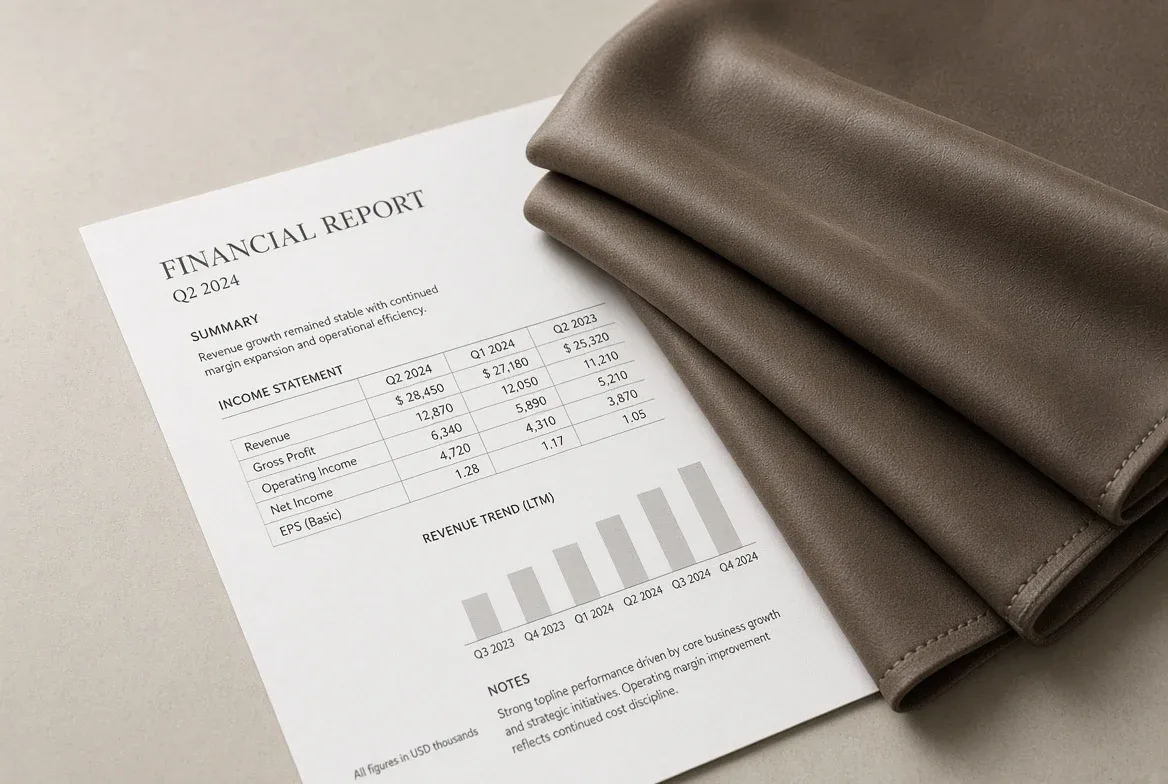
A fashion group's earnings report rewards a careful reader more than a fast one. LVMH's first-half 2026 results, published July 27 and confirmed in the group's own filing, reported €38.6 billion in revenue, down 3% on a reported basis but up 2% in organic terms — the gap between those two figures, and what sits underneath a division's number, is where the real story usually lives.
What Do "Reported" and "Organic" Growth Actually Mean?
Reported growth is the plain year-over-year change in revenue as booked. Organic growth strips out currency swings and changes in what the company owns — acquisitions, disposals — to isolate underlying demand. LVMH's own July 27 statement shows both sitting side by side: group revenue fell 3% on a reported basis while organic growth came in at plus 2%, a gap wide enough that reading only the headline number would have told a materially different story.
The distinction matters because a weak currency year can flatter organic growth while reported revenue still declines, and the reverse also happens. A euro that strengthens against the dollar, for instance, can shrink the reported value of sales already made in dollars without a single fewer handbag or gown having sold — which is precisely the effect organic-growth reporting is designed to filter out, and precisely why the two figures can move in different directions in the same release. The U.S. Securities and Exchange Commission's investor guidance is blunt about the underlying risk with any figure a company presents outside standard accounting: reviewers should note when a number is a "non-GAAP financial measure," because, as the SEC's own guide to reading a financial report puts it, those numbers "do NOT conform to GAAP" — the standardized rules audited figures must follow. Organic growth is exactly that kind of company-defined, non-GAAP figure. It is useful, but it is management's framing, not an audited fact.
Why Did the Fashion Division's Numbers Look Different From the Group's?
Inside LVMH's July 27 filing, the Fashion & Leather Goods division — the unit that houses Louis Vuitton, Christian Dior, and Loewe — posted €18.146 billion in first-half revenue, with organic growth of minus 1% for the half but plus 1% in the second quarter alone. That second-quarter figure marked the division's return to organic growth after a stretch of declines, and it is the detail worth isolating rather than folding into the group total.
A conglomerate's headline number can mask a lagging or recovering division. LVMH also owns wines and spirits, perfumes and cosmetics, watches and jewelry, and Sephora's retail business, each reported separately inside the same filing. Reading only the group total in a report like this one would have missed the fact that fashion and leather goods, the segment most exposed to discretionary luxury spending, only turned the corner in the second quarter — a full quarter behind the group average.
For a magazine tracking what happens on the runway and in campaigns, the division-level figure is the more relevant one: it is the number that reflects demand for the handbags, ready-to-wear, and leather goods a trend report actually covers, where the group total blends in wine, jewelry, and retail results that follow different cycles entirely. A reader comparing seasons is better served by the segment that matches the coverage than by the consolidated headline.
What Does Operating Margin Tell a Reader That Revenue Doesn't?
LVMH's first-half operating margin came in at 22.5%, with profit from recurring operations at €8.7 billion and group-share net profit at €5.7 billion, according to the July 27 release. Margin measures what a company keeps after the cost of running the business, so a group can grow revenue while margin erodes — a sign that promotions, input costs, or currency are eating into what each sale actually earns. A margin that holds steady alongside slower revenue growth, as LVMH's did this half, generally reads as tighter cost control rather than accelerating demand, and the two should not be conflated.
The SEC's guidance flags a related caution for any earnings document: the section where management narrates results in its own words is meant to be read alongside — never in place of — the audited statements the section is summarizing. A strong quarter described confidently in a chief executive's remarks is not itself the evidence; the line items behind it are.
How Much Should a Single Quarter's Numbers Be Trusted?
LVMH's own release attributed part of the first-half shortfall to "the conflict in the Middle East," noting that second-quarter organic growth would have reached 4% rather than 3% excluding that impact — a company-supplied estimate, not an audited figure, and worth reading as the group's own accounting of a one-off drag rather than a verified number. Regional performance inside the same filing was uneven: the U.S. accelerated, Asia outside Japan posted what the release called "strong growth," and Europe showed "good resilience," language that describes a recovery still finding its footing rather than a broad rebound.
A single half's results are one data point in a longer trend, and LVMH's chairman, Bernard Arnault, framed the quarter as the start of a longer arc, citing Christian Dior's new creative direction under Jonathan Anderson, new Louis Vuitton flagships in Beijing and Seoul, and jewelry's performance as drivers behind the acceleration. Those are named, verifiable developments — not projections — and a careful reader should treat them as context for what already happened rather than confirmation of what comes next. LVMH's board also approved an interim dividend of €5.50 per share, payable December 3, 2026, a separate capital-allocation decision from the operating results themselves.
| Measure | First Half 2026 | Second Quarter 2026 |
|---|---|---|
| Group revenue | €38.6 billion | Organic growth accelerated to +3% |
| Group organic growth | +2% | +3% (+4% excluding Middle East impact) |
| Fashion & Leather Goods organic growth | -1% | +1% (return to growth) |
| Operating margin | 22.5% | — |
Read this way, a fashion group's earnings report is less a verdict than a set of layered claims: an audited revenue figure, a company-defined organic-growth figure sitting beside it, divisional detail that can move in the opposite direction from the group total, and a narrative from leadership that explains — but does not replace — the numbers underneath.
For a related fashion news perspective, read Miami Swim Week 2024 Powered By Art Hearts Fashion.
For more context, read LVMH's Slowing Sales Signal the End of the Boom Years.