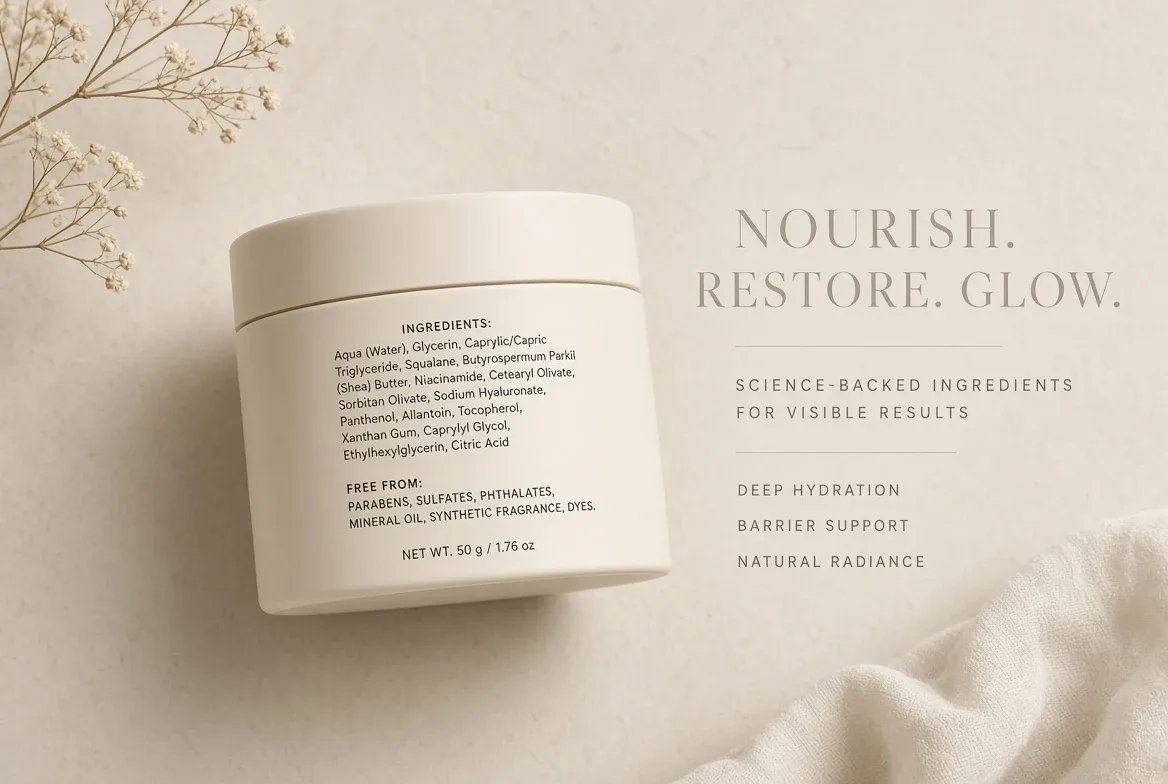
Most of the reassuring words on a beauty label carry no legal definition. The U.S. Food and Drug Administration states that there are no federal standards governing the term "hypoallergenic," and that "organic" is not defined in the laws the agency enforces. What is regulated is the ingredient declaration on the back — the part shoppers read last.
That gap between the front of the jar and the back of it — the only panel written to a federal rule — is not a scandal. It is the architecture of American cosmetics law, and it is legible once the vocabulary is sorted into what a regulator defines, what a private certifier defines, and what a brand defines for itself. The distinction changes how a label should be read, not whether a product is worth buying.
Does "Hypoallergenic" Mean Anything Legally?
No. The FDA's own guidance on the term is unusually blunt: "There are no Federal standards or definitions that govern the use of the term 'hypoallergenic.'" The agency adds that the term "means whatever a particular company wants it to mean," and that manufacturers using it "are not required to submit substantiation of their hypoallergenicity claims to FDA."
The wording is a residue of a lost fight. The FDA issued a regulation in 1975 that would have required comparative testing before the claim could be used; the U.S. Court of Appeals invalidated it in 1977, holding that the agency had not established that consumers understood the term the way the rule defined it. The claim survived; the standard behind it did not.
The agency's page also records a finding from 1978 that it knew of no scientific studies showing that products making such claims caused fewer adverse reactions than conventional ones, and states that there is no such thing as a cosmetic that can be guaranteed never to produce an allergic reaction. Read as a promise, the word overreaches. Read as a formulation posture — a maker signalling that it has tried to avoid common irritants — it is closer to honest.
Why Does "Fragrance" Cover So Much?
Because the regulation permits it. Under 21 CFR 701.3, a cosmetic label must declare each ingredient in descending order of predominance, "except that fragrance or flavor may be listed as fragrance or flavor." A blend of dozens of components can therefore appear as one word.
The FDA's guidance on fragrances in cosmetics explains the reasoning: fragrance and flavor formulas are complex mixtures of natural and synthetic ingredients, and they are the cosmetic components most likely to qualify as trade secrets. The same page notes that the agency does not have the same legal authority to require allergen labeling for cosmetics that it has for food — which is why a fragrance allergy is harder to shop around than a peanut allergy.
It also disposes of the most common label confusion. A product marked "unscented" may still contain fragrance ingredients, added in the FDA's description to mask the smell of other ingredients rather than to give the product a noticeable scent. "Unscented" describes the experience of the product. It does not describe the formula.
What Does "Organic" Certify, and Who Certifies It?
Not the FDA. The agency's guidance on organic cosmetics states that "the term 'organic' is not defined in either of these laws or the regulations that FDA enforces," pointing instead to the National Organic Program run by the Agricultural Marketing Service of the U.S. Department of Agriculture. A cosmetic making an organic claim, the FDA notes, must comply with both USDA rules for the claim and FDA rules for labeling and safety.
So the word does carry a definition — it simply belongs to a different agency, and it describes agricultural production, not skin performance. The FDA is direct about the difference: an ingredient's source does not determine its safety, and many plants, organically grown or not, contain substances that may be toxic. Certification answers how something was farmed. It does not answer how it will behave on a face.
Is "Clean" a Standard or a Marketing Position?
A position. Healthline's 2025 explainer on the category describes clean beauty as a concept with no standardized framework, with no government regulatory body controlling what may be marketed under the term. Each retailer and each brand publishes its own exclusion list, and those lists do not agree with one another.
The same piece raises the awkward corollary: high concentrations of botanical extracts are, in its account, a leading cause of skin irritation, allergic reactions, and heightened sensitivity to UV light, and it reports that substitutions made in the name of clean formulation have contributed to a rise in contact dermatitis. That is a reported finding, not a verdict on any particular product. It is enough to retire the assumption that a shorter, more botanical list is automatically a gentler one.
What Is Actually Regulated?
More than in 2022, and less than most shoppers assume. The FDA's summary of cosmetics law, updated in August 2026, states that the agency "does not pre-approve cosmetic products or ingredients, with the important exception of some color additives." Nothing on a beauty shelf has been cleared in advance the way a drug has.
The Modernization of Cosmetics Regulation Act of 2022 changed the surrounding machinery rather than that principle. Under MoCRA, manufacturers must register their facilities with the FDA and renew every two years, responsible parties must list marketed products and their ingredients with annual updates, and — in the agency's words — MoCRA "explicitly requires that a responsible person for a cosmetic product shall ensure, and maintain records supporting, that there is adequate substantiation of safety." Imported cosmetics must meet the same requirements as domestic ones.
The practical translation: the FDA now knows what is on the market and can demand the safety file. It still does not license the product, and it still does not police the adjective on the front.
Where Each Word Actually Comes From
| Label term | Who defines it | What it tells the reader |
|---|---|---|
| Hypoallergenic | No one — no federal standard, per the FDA | The brand's own intent, unsubstantiated to the agency |
| Unscented | No one | How the product smells, not whether fragrance is in it |
| Fragrance (in the ingredient list) | 21 CFR 701.3 | A permitted single-word stand-in for a trade-secret blend |
| Organic | USDA's National Organic Program, not the FDA | How ingredients were farmed, not how they perform |
| Clean | Each brand or retailer | That formulator's exclusion list, and no one else's |
| Ingredient list order | 21 CFR 701.3 | Descending predominance, with defined exceptions |
How Should the Ingredient List Be Read?
As the regulated document it is. 21 CFR 701.3 requires ingredients in descending order of predominance, and permits an alternative grouping: ingredients above one percent in descending order, then ingredients at one percent or less in any order, then color additives without respect to predominance. Position near the top is meaningful; position near the bottom is a range, not a rank.
Two exceptions matter to anyone tracking a sensitivity. Fragrance and flavor may be declared as single words, and ingredients granted an FDA exemption from disclosure may be replaced at the end of the list by the phrase "and other ingredients." Those are the two places where the regulated document stops being fully specific — and they are the two places worth noticing.
The verdict: the front of the package is a brand's language, the back is the law's. Neither is a promise about a particular face. But only one of them is written to a standard, and it is the one printed smallest.
For a related business news perspective, read How to Read a Fashion Group's Earnings Report: A Guide.
For more context, read Skin Cycling, Explained by the Dermatologist Who Named It.